
Happy Resentment Day
Status, Selfishness and Secession

This week, people on either side of the 49th parallel are singing anthems on their national days, filling their lungs with patriotic pride. But pride in one’s place can mask an old, dark engine of human history. The American republic emerged from an explosive rupture fuelled by resentment. Today, the republic is in an existential crisis, its checks and balances broken by an elite-driven populism channeling that tectonic force, resentment.
Donald Trump channels the most resentment in human history. Trump, interested only in checks that increase his bank balances, has this week been crowned by his Supreme Court with yet more executive power. Trump now claims more executive power than any English king has enjoyed since Henry VIII, another resentful, fat, old lecher unchecked by a lapdog legislature, gleefully shattering institutions at home and abroad.
Meanwhile, north of 49, the fabric of the Canadian federation is fraying as Alberta prepares for a referendum this fall that openly flirts with secession. Like Trump, Alberta separatists are seething with resentment. They forget that their country was born as a reaction against resentment.
Resentment, fostered by prosperity, seeds secession. Then, as now.
Then: 250 years ago, by every standard, the white male colonists of British North America enjoyed the highest quality of life in the civilized world. With an abundance of cheap, fertile land and superior nutrition, the average American colonist was three inches taller than a British Islander.
British Americans lived longer. Each American colonist owned far more land and possessed a degree of personal and political autonomy that commoners in England could only dream of. (Let’s leave aside, for the moment, that all of this is undergirded by the dispossession of other people’s land and personal autonomy.)
Yet, it was precisely this extraordinary material privilege that made British Parliamentary rule so intolerable to some elite Americans. The colonial elites did not rebel because they were poor. They rebelled because they were rich enough to feel entitled to total self-determination. Any attempt by London to levy a modest tax to pay down the debts of the Seven Years’ War was interpreted not as a fiscal adjustment, but as a Popish plot to reduce them to political slavery.
In our continental history, secession movements have been built on a foundation of material wealth, driven by a burning resentment about being restrained in how that wealth is produced and shared. This was the case in 1776 and 1861, when the United States experienced bloody civil wars provoked by independence movements.
We see the same psychological architecture operating in modern Canada. Alberta’s elites preach a gospel of grievances intended to provoke political alienation, culminating in Premier Danielle Smith’s upcoming October 19, 2026 referendum, asking if she should hold a binding vote on separating from Canada entirely.
To an impartial observer, Alberta’s grievances might seem irrational. There were no Europeans living in Alberta when Canadians were fighting American invaders in Montreal in 1776. In Halifax in 1776, a thousand of the continent’s earliest European settlers arrived as penniless refugees to found Canada after their brothers in Boston had stripped them naked and poured boiling oil on them because they had opposed the American independence movement.
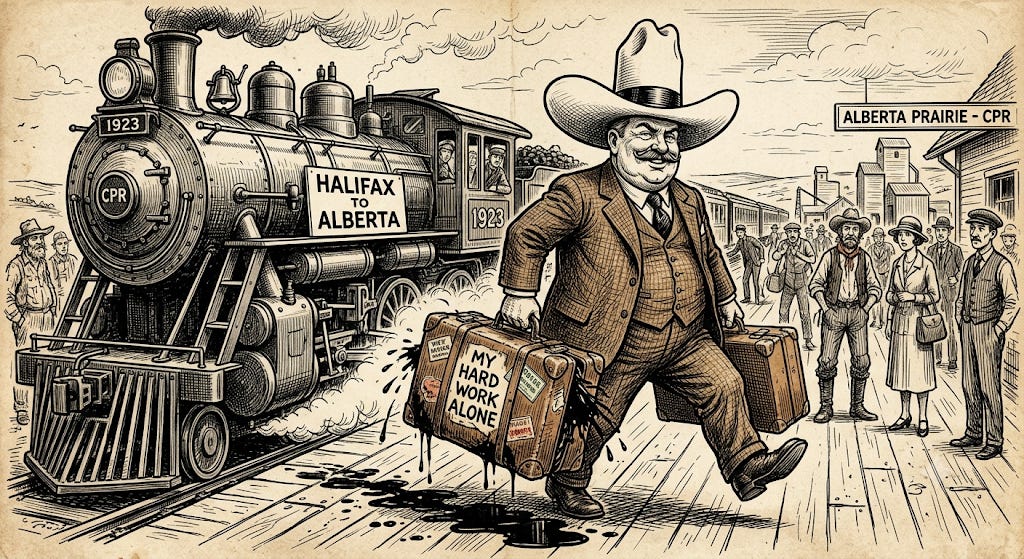
A century later, from 1872 to 1930, European settlers could ride a railroad (created by an act of Canada’s Parliament) from Halifax or Montreal to the Rockies, step off the train and get 160 acres of free land granted by Canada’s Parliament.
After Parliament granted Alberta residents the benefit of administrative autonomy within a country founded long before they arrived, they then won the geological lottery ticket of the oil sands, becoming Canada’s richest citizens as a result.
Today, some Albertans act like they carried all that oil in their luggage on the train from Halifax.
Within Alberta, this material success is precisely what fuels the right-wing autonomy movement. Their ahistorical narrative frames Alberta as an economic powerhouse trapped in a parasitic relationship. They frame the federal equalization program, which redistributes a small portion of petroleum revenues to less affluent citizens, as theft.
Alberta’s resentment is also exacerbated by seeing that Quebec’s status as the pampered partner in the Canadian federation has been achieved by the steady extortion of secession threats. The confidence of Quebec separatists to play the extortion game is buoyed by its immense energy resources.
It’s not just Albertans who find it grating to hear Quebeckers moralize about Alberta’s “dirty” energy industry while boasting that theirs is the “cleanest” economy in North America. All of Canada resents the hypocrisy of Quebec separatism.
The massive northern rivers that feed Hydro-Québec’s mega-projects are what fuels the confidence of Quebec’s independence movement. But this territory was not part of Quebec in 1776 or 1867, when Quebec was a fraction of its present boundaries.
Like Alberta’s petroleum bounty, Quebec’s energy wealth is a grant from the rest of Canada, made in good faith by Parliament in 1912. Twenty years later, that same Parliament would grant Alberta (newly carved out of the same North-West Territory as most of modern Quebec) the ticket to its future wealth.
The independence movements of Quebec and Alberta follow the historical pattern of earlier American secessionist movements. A central government expands a region’s perimeter and hands it the keys to immense natural wealth, only for that region to later weaponize that very wealth to demand autonomy from the centre.
As we mark these midsummer holidays in 2026, these historic lines of resentment are colliding in ways that are actively rewriting the continental order. The stress test of a political system is whether its institutions can withstand the corrosive power of a grievance-driven movement. In the United States, the constitutional architecture designed by the Founders is facing its most severe stress test.
The original system was intentionally designed to prevent raw public passion and ambitious factions from capturing total control of the state. But the modern populist movement operates on the con that the system itself is the enemy. By dismantling institutional norms, the ultimate elite populist has created a landscape where the balance of powers is no longer a self-sustaining machine, but a fragile perimeter under daily siege.
This American turbulence has triggered a plot twist in Canadian politics. For decades, the standard playbook for a Quebec nationalist was to rage against Ottawa and threaten to break up Confederation. But this very week, the Trump administration has intentionally blown past the mandatory CUSMA trade agreement review deadline, prolonging massive continental economic uncertainty.
This external threat inverts the psychology of Quebec. Polling trends indicate a sustained surge in federalist sentiment within the province. For the first time in a generation, the people of Quebec are looking at the Canadian federation not as a historical cage, but as a shield against an unpredictable, aggressive southern neighbour. The old anti-Ottawa resentment has been temporarily shelved in favour of a pragmatic survival instinct.
Alberta separatists are moving in the opposite direction, importing Trump-style anti-establishment rhetoric, with promises of MAGA funding after meetings in Trump’s White House. They are capitalizing on a bimodal distribution of public distrust, using federal immigration numbers and environmental targets to convince their base that Alberta must claim sovereignty.
The lesson of July 2026 is that resentment is a key element in the periodic table of politics. It is an emotional state that can lie dormant for decades, only to flare into a wildfire once a population is told its prosperity is under threat by outsiders (e.g., immigrants, or the federal government).
The American Founders understood the power of resentment because they used it to build a republic. But they also left behind explicit warnings about its volatility. They knew that an excess of grievance, and a lack of gratitude, could easily blind a society to the value of its own institutions, leaving it vulnerable to leaders who promise justice but deliver disruption.
As the fireworks go off this week from Boston to Edmonton, the message echoing across the centuries remains the same. In the bounteous lands of the North American continent bequeathed by the British Empire’s dispossession of non-Europeans, people do not revolt when they have nothing to lose. They revolt when they have everything given to them, and they resent sharing it.
-30-
I’m grateful for your time and consideration. As the president says, “Thank you for your attention to this matter!” Comments on Substack are more than welcome - they help engage and grow debate. Subscriptions, paid or free, are also welcome.
Well done George .. well worth the read!
Happy Canada George - hope you’re feeling strong these days. Love your always very well presented writings - as someone who’s spent a significant part of my life in both Alberta and Quebec as well as now more than half in Ontario there certainly are regional differences on what might be “resented” - in different parts of our country - generally people seem to be focused locally on what matters most to them. What surprises me most is when people spend more time focused on what happens beyond our borders rather than the policies and regulations we impose upon ourselves that limit the abundance of what we have within our own Canadian borders to allow us all to prosper - perhaps a little more accountability and focus on actual results - no matter where we live I believe that people resent wasteful spending - that belief needs to be supported by a media who actually holds governments in power to be accountable - that seems to be sorely lacking but I digress and potentially reveal my biases😂